Customer psychographic framework
Your Customers Have the Words Your Brand is Missing
Anyone can generate brand copy now with AI, but almost nobody knows how to sit down with real customers to find out what's true first. There is a way to understand your customer's perceived reality around the very problem your business solves.
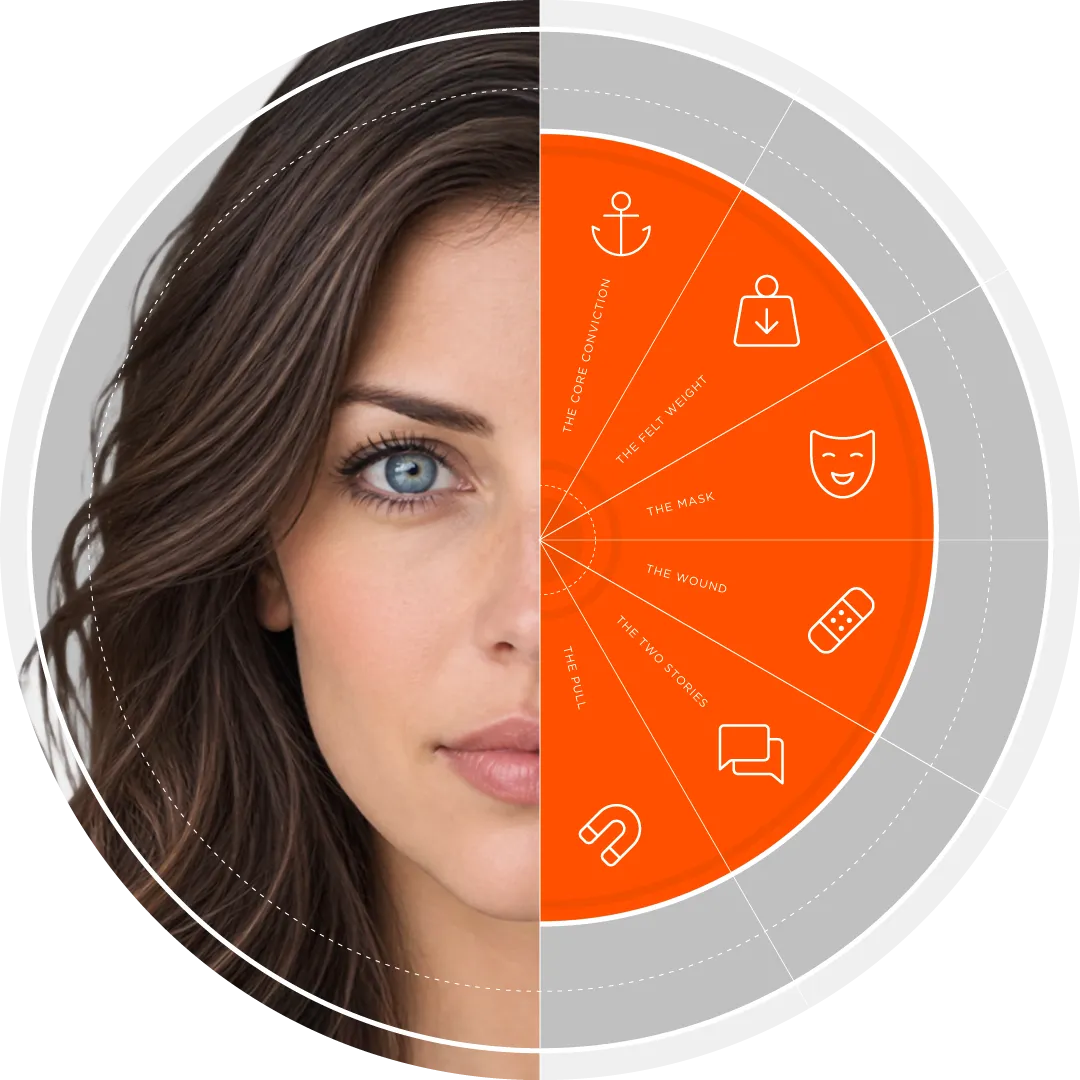
Their Words • Your Brand • No Guessing
Their Words
Your Brand
No Guessing

The problem
Truth That Goes Deeper Than Demographics
Your customer walks into every purchase carrying a core conviction, a private day to day frustration, an identity-level wound, and a specific fears that she's never said out loud and never been asked about.
None of that shows up in a demographic profile. It shows up in the six layers underneath it, and until your messaging reaches those layers, you're writing to a description instead of a person.
The framework
Introducing the Customer Perception Profile, or CPP
These are the six psychological layers your current persona is blind to. These are forces that actually exist in real buyers, mapped from the customers you already have access to right now.

The Core Conviction
The belief they formed long before your brand ever entered the picture.

Felt Weight
The daily tax of a conviction meeting a reality that keeps violating it.

The Mask
The version they presents in public, one they have started to believe themselves.

The Wound
The identity-level injury underneath the surface complaint they lead with.

The Two Stories
What they say to others versus what they actually feel. Rarely the same sentence.

The Pull
The desired state they feel drawn to like gravity. What they long for at 2am.

Creator of the cpp
Meet Steve Reed
Steve Reed is the founder of Vectyr and the creator of the Customer Perception Profile. After twenty-two years in brand strategy, one persistent problem with every buyer persona was that it described the customer, and how the founder saw their reality, but it explained nothing deeper about their perceived reality around the problem itself.
Some unique personal experiences provided the groundwork for the Customer Perception Profile that he built to fix that.
How it works
The Process
Real customers. Real data. One document at the end, built around the specific problem you're trying to solve.
Step 01
Customer Conversations
Five to ten conversations with your actual customers, using questions built to surface each of the six psychographic layers around the problem you're trying to solve.
Step 02
Data Validation
Hundreds of additional data points pulled from reviews, forums, and other public sources, checked against the patterns the interviews surfaced.
Step 03
The Profile
One markdown document. A problem statement, an intensity reading, and all six layers translated into sample brand language you can put straight into your marketing.
Finding fit
Where This Fits
This is not designed to replace whatever persona systems you are already using; it's the psychological layer they are missing. Keep Revella. Keep Andrews. Keep whatever template your agency swears by. The Customer Perception Profile adds the words your clients already use that you can reflect back to them.
This is Not Built For:
Anyone who doesn't value how their customers describe the way they perceive their problems, are still deciding whether customer psychology moves the bottom line, or can't interview customers.
This is Built For:
B2C founders, marketers, strategists, and consultants, who have already tried the standard approach and felt the gap it left behind. They want to fill that gap with something tangible rather than more guessing.
Get your CPP
Customer Perception Profile Pricing
This is done for you, start to finish. One markdown file, built from what your customers actually told us and checked against hundreds of other data points we source that back it up.
A problem statement, specific to the issue you brought us
An intensity reading for that problem
All six Customer Perception Profile layers
Sample brand language for each layer, ready to put in front of a client or a campaign
$1,995
One time buildout fee for a single Customer Perception Profile mapped out for your business.
5 to 10 customer interviews included
Got Questions?
How much of my time will this take?
We start with a kick-off call to learn more about your business and customers. The most important thing is that you can articulate the specific problem you are trying to solve with your business. We will send you a calendar link specifically for your business and ask you to send it to at least ten of your most ideal customers. If you do not have at least 10 customers for us to interview, you will need to have at least 10 people that fit your ideal customer profile that are experiencing the problem that your business was created to solve.
How long does it take to create a Customer Perception Profile?
Typically, it can take about 5 business days, with a lot of that time being the space in between interviews due to customer's availability.
How do I know if this is right for my business?
The Customer Perception Profile works best when we have customers who fit your ideal profile that we can interview. These are usually B2C companies, and where the intensity of physical pain and/or psychological frustration would be more medium or high rather than low.
Are my customers going to be asked questions that make them uncomfortable?
Right at the beginning, we point out that the questions we ask are not intensely personal and if there is any question they do not feel comfortable asking that they can simply "pass" or answer the question in a way that they feel comfortable. Rather than being an interrogation, we conduct these sessions in a way that is conversational and to date, every conversation has been a positive experience.
Do you record audio of the conversations?
We do not record audio, but we do transcribe the conversations because the actual words they use are critical to get right. We also take notes along with the transcriptions so that we capture the full context of their experiences.
Are you asking them about their experience with my company?
We actually don't talk to them about their experience with you for an important reason. While that information is important, the purpose of the Customer Perception Profile is to take them back to before they experienced your solution, when they were in the heat of the problem, and explore how that problem affected them across all six layers of the profile.
We can ask for testimonials at the very end of the conversation, and if they desire to provide one, we share those testimonials with you.

© 2026 Vectyr. All Rights Reserved.